Event report • Webinar
Webinar: Next-Generation Health led by French leaders: From Medical Imaging to Advanced Surgery
Part of the Future of Health Webinar Series - Essential strategies to navigate the transition from innovation to commercialization
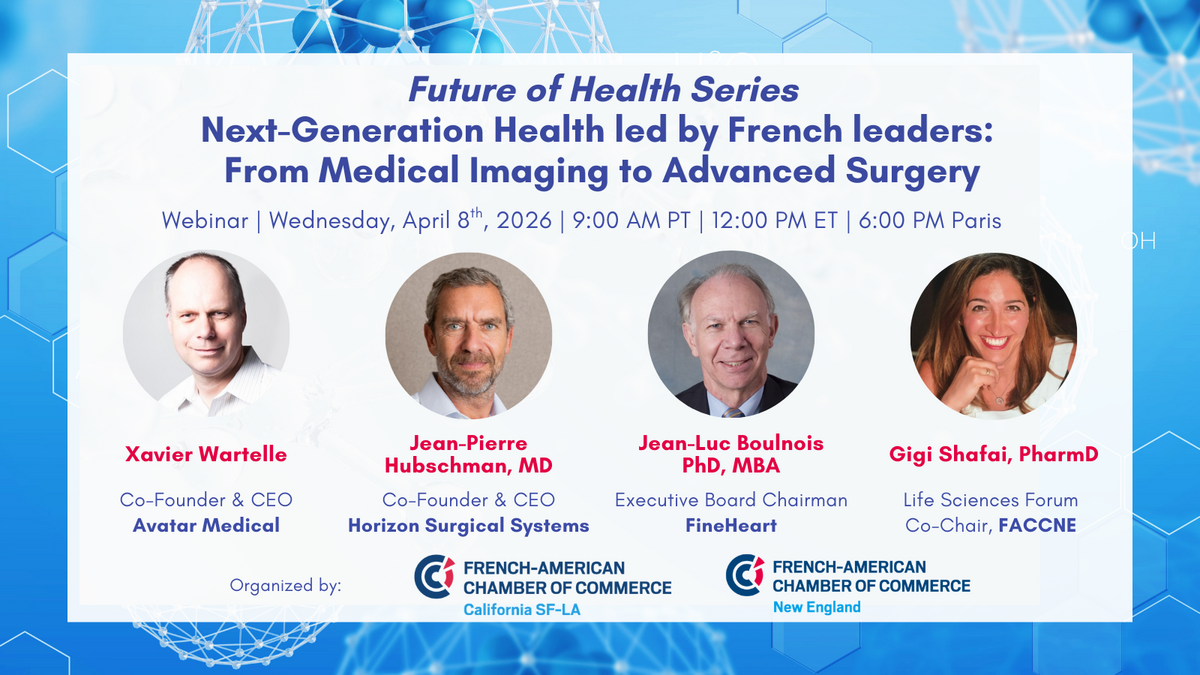
Part of the Future of Health Webinar Series, this collaboration between the FACC New England and FACC California, featured industry veterans discussing the complexities of scaling MedTech and medical device innovations in the U.S. market.
Moderated by Gigi Shafai, PharmD, Co-Chair of FACCNE's French-American Biotechnology Springboard, the discussion highlighted essential strategies for French entrepreneurs navigating the transition from European innovation to American commercialization.
Featured Speakers:
- Xavier Wartelle, Co-founder & CEO, Avatar Medical (real-time 3D imaging that improves patient understanding and drives better clinical decisions)
- Jean-Pierre Hubschman, MD, Co-founder & CEO, Horizon Surgical Systems (robotics for cataract surgery)
- Jean-Luc Boulnois, PhD, EMBA, Executive Board Chairman, FineHeart (innovative medical devices for cardiology)
1. Defining "Value" for the U.S. Healthcare System
To succeed in the U.S., a technology must do more than just function well; it must provide a clear economic and clinical justification for adoption.
- The Double Benefit: Products must simultaneously offer an incontrovertible patient benefit and a clear economic benefit for the provider.
- Patient Retention as a Driver: For hospitals, value is often found in tools that improve the patient experience and trust, which directly leads to higher patient retention and increased revenue.
- Focus on Adoption, Not Just Tech: Investors are primarily concerned with adoption: who will pay for the technology and how quickly it will be integrated into existing clinical workflows.
2. Strategic "De-risking" for Fundraising
In the current risk-averse financial environment, founders must systematically de-risk their companies to attract capital.
- The Four Pillars of De-risking: Investors look for clarity in technology validation, regulatory pathways (FDA), clinical data, and reimbursement strategy.
- Strategic Partners: Having a "strategic" player on the cap table validates the market opportunity and significantly helps in attracting Venture Capital.
- Data Accuracy: It is vital to collect the right data; the data required by the FDA for approval is often different from the data clinicians want to see for daily practice.
3. Navigating the Cultural & Business Transition
The panel emphasized that moving a business from France to the U.S. is not a simple "copy-paste" exercise; it requires a total mindset shift.
- Live Where You Work: To truly understand the American business culture and customer expectations, founders should ideally live in the U.S. rather than managing from abroad.
- Humble Adaptation: Regardless of past success in Europe, French leaders must be prepared to prove their value again within the U.S. ecosystem and be humble enough to learn from local experts.
- The Sales Mindset: While European engineering is highly respected, there is often skepticism regarding European "sales" ability. Founders must embrace the U.S. culture of "selling" their vision to every stakeholder.
4. Building Credibility with Stakeholders
- Medical Societies: Early endorsement from major U.S. medical societies (e.g., American Heart Association) is a critical asset for both clinical acceptance and obtaining reimbursement codes.
- KOL Selection: Quality is better than quantity; founders should focus on a few highly influential Key Opinion Leaders (KOLs) who can validate the product's value proposition and drive clinical studies.
- Bicultural Teams: Building a strong local U.S. team is essential for navigating the complex cultural and commercial nuances of the healthcare market.
See the event page here.