Webinar • Members
FACCNE Is Thrilled to Promote | Live Webinar by FACCNE Member Genoskin: Understanding Human Wound Healing at Cellular Resolution
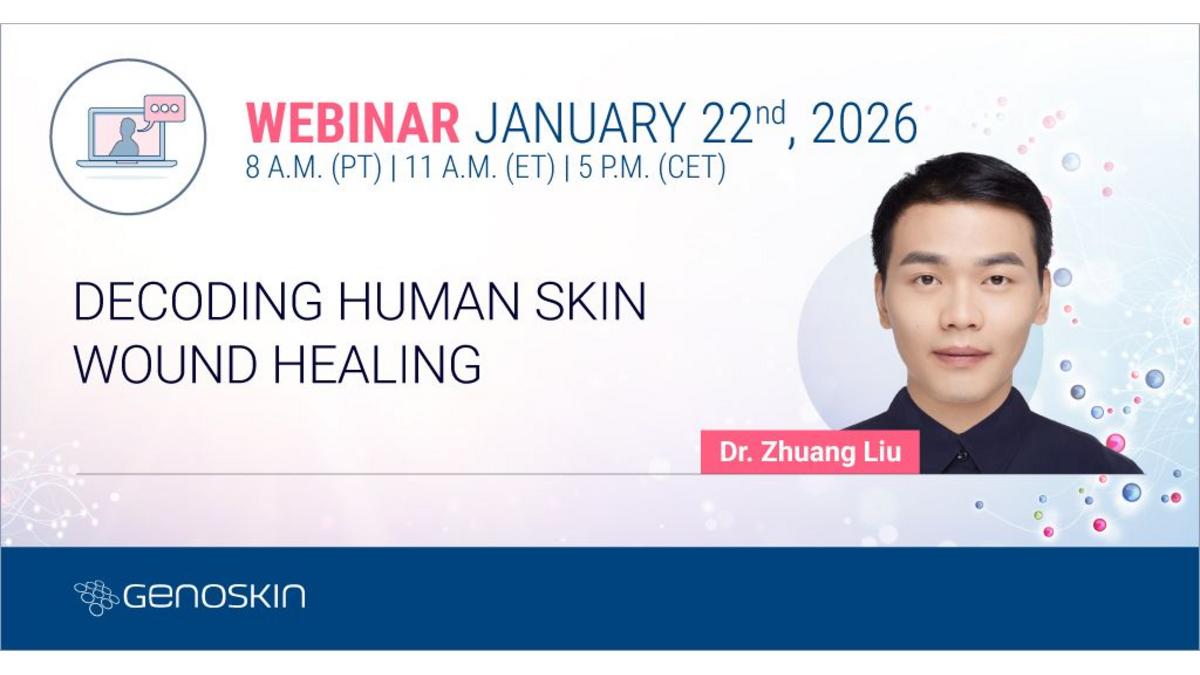
Discover how human skin heals at the cellular level. Join Genoskin’s live webinar exploring breakthrough insights in wound healing research.
How does human skin repair itself - cell by cell? Effective wound healing relies on highly coordinated processes such as re-epithelialization and cell migration, yet many of these mechanisms are still not fully understood.
Join Genoskin for an in-depth webinar where Dr. Liu will share findings from a human in vivo wound-healing model. Using single-cell multi-omics, this research sheds new light on the cellular interactions and transcriptional programs that drive successful tissue repair.
? January 22
? 8:00 a.m. PDT | 11:00 a.m. EDT | 5:00 p.m. CEST
? Register to join the live discussion: https://lnkd.in/e65TAjMq
Decoding human skin wound healing
Wound healing relies on coordinated cellular responses that restore the skin barrier, with re-epithelialization as a critical step. When this process fails, as commonly seen in diabetic foot ulcers and venous ulcers, chronic wounds develop. Therapeutic progress has been slow, largely because the mechanisms that govern wound healing in human skin are still not well understood.
In this talk, Dr. Liu will present findings from his group’s recent studies using a human in vivo skin wound healing model. By profiling cells from unwounded skin and wounds at days 1, 7, and 30, the team generated a high-resolution single-cell multi-omics atlas that maps how
keratinocytes, fibroblasts, macrophages, endothelial cells, and other cell types change throughout healing.
Their work identifies FOSL1 as a central transcriptional driver of re-epithelialization and shows how macrophages and fibroblasts coordinate keratinocytes migration in a phase-dependent manner. By integrating data from venous ulcers and diabetic foot ulcers, the study also uncovers key disruptions that prevent chronic wounds from activating proper repair programs.
Together, these studies provide a foundational resource for understanding human wound healing and highlight new therapeutic opportunities that may help restore effective repair in chronic wounds.
About the Speaker
Dr. Zhuang Liu
Assistant Professor, Karolinska Institutet
Education and Training:
Ph.D., China Agricultural University
Dr. Zhuang Liu is an Assistant Professor at Karolinska Institutet, where he investigates how human skin heals after injury. He earned his Ph.D. in Bioinformatics from China Agricultural University, gaining strong experience in genomics and data analysis. Since joining Karolinska Institutet as a postdoc in 2019, he has focused on understanding why some wounds heal successfully while others become chronic. He began by studying RNA-based regulatory mechanisms in healing and non-healing wounds, and later expanded his work to single-cell and spatial technologies to map how individual skin cell types behave during repair. These studies have revealed new interactions among keratinocytes, fibroblasts, and immune cells, providing valuable insights that may guide the development of better treatments for chronic wounds.
Additional resources on Dr. Abraham’s research
Spatiotemporal single-cell roadmap of human skin wound healing
Liu Z; Bian X; Luo L; Bjorklund AK; Li L; Zhang L; Chen Y; Guo L; Gao J; Cao C; Wang J; He W; Xiao Y; Zhu L; Annusver K; Gopee NH; Basurto-Lozada D; Horsfall D; Bennett CL; Kasper M; Haniffa M; Sommar P; Li D; Landen NX
Cell Stem Cell. 2025;32(3):479-498.e8
Single-Cell Analysis Reveals Major Histocompatibility Complex II-Expressing Keratinocytes in Pressure Ulcers with Worse Healing Outcomes
Li D; Cheng S; Pei Y; Sommar P; Karner J; Herter EK; Toma MA; Zhang L; Pham K; Cheung YT; Liu Z; Chen X; Eidsmo L; Deng Q; Landen NX
Journal Of Investigative Dermatology. 2022;142(3 PT A):705-716
The lncRNA SNHG26 drives the inflammatory-to-proliferative state transition of keratinocyte progenitor cells during wound healing
Li D; Liu Z; Zhang L; Bian X; Wu J; Li L; Chen Y; Luo L; Pan L; Kong L; Xiao Y; Wang J; Zhang X; Wang W; Toma M; Piipponen M; Sommar P; Landen NX
Nature Communications. 2024;15(1):8637